

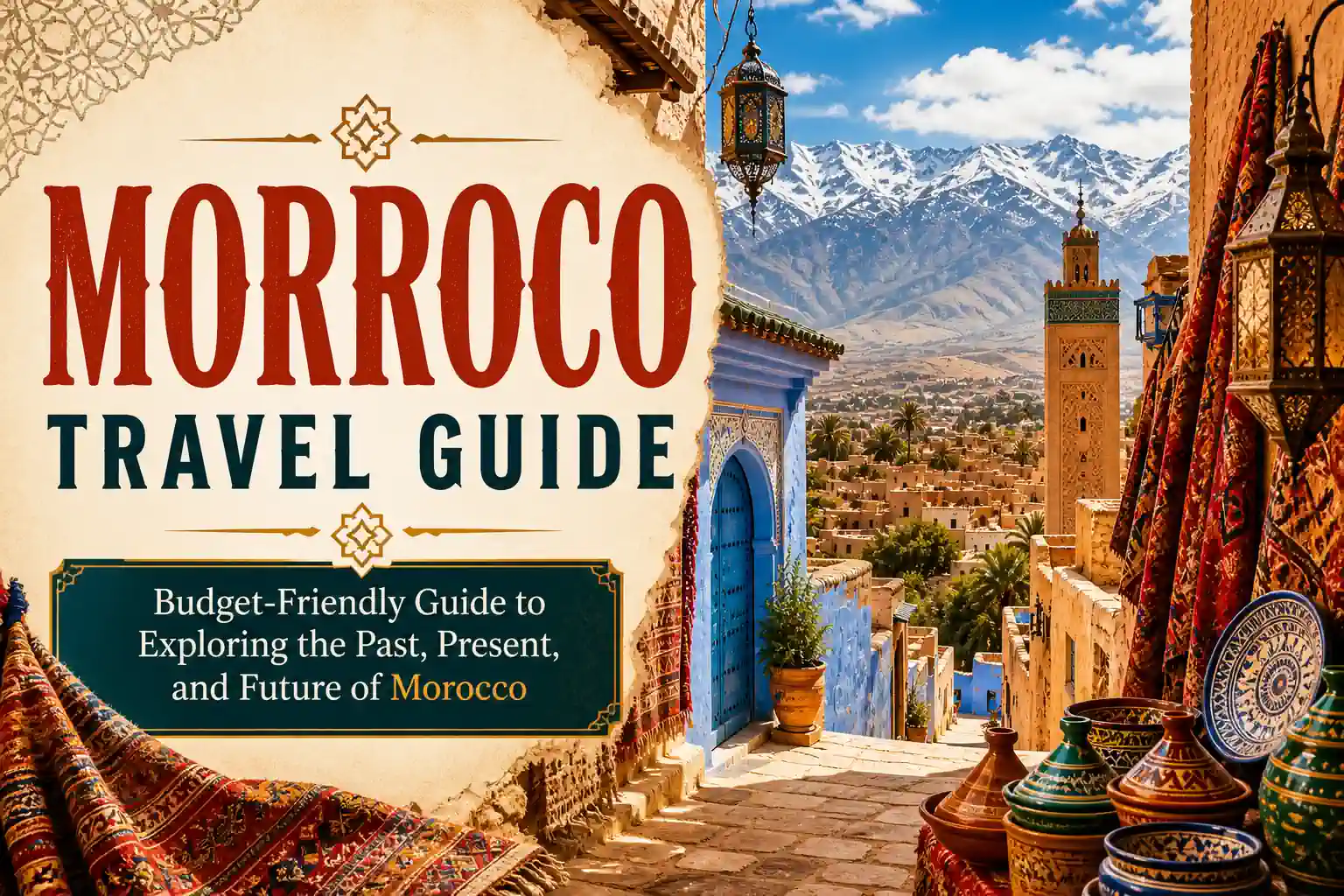
Morocco Travel Guide
The Land Where the
Desert Meets the Sea
.jpeg "Earn Passive Income with Wall Art")
Your complete guide to exploring Morocco in 2026 — from ancient medinas to the infinite Sahara, on any budget.

01 —Why Visit Morocco in 2026?
Morocco is one of those rare countries that genuinely has it all. In the span of a single week, you can wake up in a centuries-old riad in Fes, ride a camel across the Sahara at dusk, hike through cedar forests teeming with Barbary macaques, and dine on the freshest seafood on the Atlantic coast — all without ever feeling like you’ve exhausted what the country has to offer.
But 2026 in particular is a spectacular moment to visit. Morocco is midway through one of the most ambitious infrastructure and cultural investment programmes in its modern history, partly in anticipation of co-hosting the 2030 FIFA World Cup alongside Spain and Portugal. New high-speed rail lines are extending beyond Casablanca-Tangier, airports are expanding, and a wave of boutique accommodation and cultural institutions is opening across the country — all while the heart of Morocco, its ancient medinas and Berber villages, remains gloriously, defiantly unchanged.
Morocco doesn’t just offer a holiday. It offers a reckoning with beauty — of architecture, of food, of hospitality — that most travelers aren’t fully prepared for.
The country straddles three worlds: the Arab, the Berber (Amazigh), and the European (with strong French and Spanish influences), and this collision produces a culture of extraordinary richness. Add to this the sheer physical diversity — Mediterranean coastline, Atlantic surf towns, snow-capped mountains, and the world’s largest hot desert — and you begin to understand why Morocco keeps drawing travelers back, year after year.
Top reasons to visit in 2026
- World Cup infrastructure investments mean better transport and facilities
- New high-speed train routes connecting major cities
- Expanding eco-tourism in the Atlas Mountains and desert regions
- Strengthened dirhams-to-dollar/euro exchange rate: your money goes further
- Less crowded than European equivalents at a fraction of the cost
- Year-round mild coastal climate with desert stargazing from September–April
02 —Erg Chebbi & Erg Chigaga — Morocco’s Desert Soul
The Sahara is Morocco’s most iconic image — and it earns every cliché. The two main sand sea regions, Erg Chebbi near Merzouga in the east and the more remote Erg Chigaga near M’Hamid in the south, offer vastly different experiences.
Erg Chebbi — the accessible classic
The towering orange dunes of Erg Chebbi reach up to 150 metres — some of the highest in North Africa — and glow amber and crimson at sunrise and sunset in ways that no photograph quite captures. The town of Merzouga is the gateway, a dust-edged village that has grown accustomed to travellers and offers everything from budget guesthouses to extraordinary luxury desert camps with plunge pools and traditional music performances under the stars.
The most popular experience is the classic camel trek at dawn or dusk, spending a night in a Berber desert camp, and waking before sunrise to climb the highest dune while the landscape turns from deep violet to burning gold. Book directly with local Berber guides rather than through city-based agencies — you’ll get a better experience and more of your money reaches the community.
Erg Chigaga — the road less drifted
Erg Chigaga requires either a 4WD journey (roughly 55km of piste from M’Hamid) or a 2–3 day camel trek and rewards the effort with near-total solitude. The dunes here are even larger, the silence is absolute, and the Milky Way on a clear night is among the most spectacular sky views on Earth. Fewer than a handful of permanent camps operate here, each carefully chosen and sustainably managed.
💡 Best time to visit the desert: October through March. Summer temperatures can exceed 45°C — dangerous for extended outdoor activities. Spring (March–April) brings occasional sandstorms but spectacular light.
03 —Historical Wonders — Exploring Morocco’s Rich Past
Morocco’s recorded history stretches back over 3,000 years, and its UNESCO-listed medinas, Roman ruins, and Amazigh kasbahs form one of the densest concentrations of historical heritage in the world. Unlike many countries, Morocco’s past is not confined to museums — it is alive in the streets, in the call to prayer echoing across tile rooftops, in the hands of an artisan cutting cedar wood in the same pattern his grandfather used.
Volubilis — the Roman empire’s western edge
An hour’s drive north of Meknes, Volubilis is the best-preserved Roman city in North Africa and the westernmost point the empire reached. Wandering its mosaic floors, triumphal arches, and colonnaded streets, it’s easy to forget you’re in Morocco at all. Go in the early morning when tour groups haven’t yet arrived and the light is low and golden.
Ait Benhaddou — Hollywood’s favourite kasbah
The UNESCO-listed ksar of Ait Benhaddou, set dramatically against the High Atlas foothills near Ouarzazate, has served as a backdrop for films including Gladiator, Lawrence of Arabia, and Game of Thrones. A small number of families still live within its walls. Walk up to the granary at the top before 8am and you’ll have it entirely to yourself.
Meknès — the forgotten imperial city
While Marrakech and Fes dominate the tourist trail, Meknès — once the capital under Sultan Moulay Ismail — is frequently overlooked. Its monumental Bab Mansour gate, the vast Heri es-Souani granaries, and the relaxed, genuinely local medina make it one of Morocco’s most rewarding stops, with a fraction of the crowds found elsewhere.
04 —Budget Travel — How to Explore Morocco Without Breaking the Bank
Morocco is one of the most affordable destinations accessible from Europe and North America. A comfortable, experience-rich trip can be done on $40–55 USD per day, including accommodation, food, local transport, and activities. Backpackers can get by on $25–30; those who want boutique riads and guided experiences might spend $80–120.
| Category | Budget | Mid-Range | Comfort |
|---|---|---|---|
| Accommodation (per night) | $8–15 | $25–60 | $70–180 |
| Meals (per day) | $6–10 | $15–25 | $30–60 |
| Inter-city transport | $3–8 | $10–25 | $30–80 |
| Activities (per day) | $5–12 | $15–35 | $50–150 |
| Daily Total (est.) | $22–45 | $65–145 | $180–470 |
Top money-saving strategies
Budget hacks that actually work
- Book riads directly (WhatsApp the owner) — skip booking platforms and negotiate, especially for 3+ nights
- Eat at hole-in-the-wall fondouks and market stalls — the food is better and costs a quarter of tourist restaurants
- Use CTM or Supratours long-distance buses — comfortable, safe, and 4–6x cheaper than taxis
- The ONCF national train is excellent and cheap: Casablanca to Marrakech costs about $10 in second class
- Never accept the first price in a souk — expect to pay 30–50% of the opening ask
- Carry small denomination dirhams — attractions and hammams often can’t change large bills
- Avoid Djemaa el-Fna restaurant terraces — the food is overpriced and mediocre; the views are free
05 —Exploring the Historic Cities — Marrakech, Fes, and Rabat
Morocco’s imperial cities are its beating heart — and each one could comfortably occupy a week of your time on its own. Here’s a brief orientation to help you decide where to focus.
Marrakech
The Pink City. Chaotic, sensory, unforgettable. Best for first-timers, souks, hammams, and the Djemaa el-Fna. Allow 3–4 days minimum.
Fes
The spiritual and intellectual capital. Its 9th-century medina, Fes el-Bali, is the world’s largest car-free urban area. Allow 3+ days; hire a guide for day one.
Rabat
Calm, walkable, and underrated. The Kasbah of the Udayas and the Hassan Tower are world-class. A perfect decompression day after Marrakech or Fes.
Chefchaouen
The legendary blue-washed medina in the Rif mountains. Smaller, calmer, and extraordinarily photogenic. Excellent base for hiking. Stay 2 nights minimum.
Fes is not a city you visit. It is a city that visits you — its alleys, its sounds, its smell of cedar and leather and cumin seeping into memory for years afterward.
The recommended circuit for a 10–14 day trip: Casablanca arrival → Rabat (1–2 nights) → Fes (3 nights) → Chefchaouen (2 nights) → Meknes (1 night) → Marrakech (3 nights). This can be done entirely by train and CTM bus without renting a car.
06 —Natural Wonders — From the Sahara to the Atlas Mountains
Morocco’s landscapes are as dramatic as they are varied. Within a single country you’ll find Atlantic beaches, Mediterranean coves, five distinct mountain ranges, subtropical forests, river gorges, volcanic plains, and the full sweep of the Sahara.
The High Atlas
Toubkal National Park contains Jebel Toubkal (4,167m), the highest peak in North Africa and a surprisingly accessible summit — experienced trekkers can reach the top in two days from Imlil, a village just 60km from Marrakech. The valleys around Asni and Ourika offer gentler walks through Berber villages, saffron fields, and walnut orchards.
The Draa Valley and Gorges
The Draa Valley — stretching from Ouarzazate south toward M’Hamid — is one of Morocco’s most beautiful drives, lined with oasis palms, ancient kasbahs, and kilometre after kilometre of date palms. Detour through the Dadès and Todra Gorges for some of the most spectacular canyon scenery in Africa, where sheer walls rise up to 300 metres above narrow river beds.
The Cedar Forests of the Middle Atlas
Near Azrou, ancient cedar forests stretch across the Middle Atlas plateau — home to large troops of Barbary macaques, Morocco’s only wild primate. The forests are hauntingly beautiful in mist, and the drive from Fes through Ifrane and Azrou is one of the country’s most scenic routes.
07 —Moroccan Cuisine on a Budget — Where and What to Eat
Moroccan food is one of the world’s great cuisines — slow-cooked, intensely spiced, built on centuries of Arab, Berber, Andalusian, and French culinary influence. And unlike many great food cultures, eating brilliantly in Morocco does not require spending much money at all.
- Tagine Slow-cooked lamb, chicken or vegetable stew in a conical clay pot with preserved lemon, olives, and fragrant spices. The national dish, found everywhere. $2–5
- Harira A thick, nourishing tomato and lentil soup with chickpeas, herbs, and vermicelli. The traditional soup for breaking Ramadan fast — available year-round for breakfast and lunch. $0.50–1
- Bissara Creamy split pea or fava bean dip served with argan oil, cumin, and crusty bread. The ultimate budget breakfast in northern cities. $0.50–1
- Pastilla Extraordinary sweet-savoury pie of shredded pigeon (or chicken), almonds, cinnamon, and eggs in paper-thin warka pastry dusted with powdered sugar. A Fes specialty. $4–8
- Mechoui Whole lamb slow-roasted in a clay oven, carved tableside and eaten with cumin and coarse salt. The feast food. Find it in the souks of Marrakech from midday. $3–6 (portion)
- Sfenj & Mint Tea Fried dough rings — Morocco’s doughnuts — sold fresh from street stalls, paired with a glass of heavily sweetened mint tea poured from height. The perfect breakfast. $0.50–1.50
🍽️ Where to eat well and cheaply: Look for the fondouks (workers’ canteens) near market areas and bus stations. Order the plat du jour — a full 3-course meal including bread, salad, tagine and tea for $3–5. Avoid any restaurant with a photo menu outside and a tout in the doorway.
08 —Cultural Etiquette Every Traveler Should Know
Morocco is a Muslim-majority country with deep traditions around hospitality, modesty, and respect. Understanding the social context of where you are — and adjusting accordingly — will transform how locals receive you and how richly the culture opens up.
Dress modestly in medinas
Cover shoulders and knees in old cities, religious sites, and smaller towns. Beachwear is for the beach only. Women receive considerably less hassle when dressed conservatively.
Greet first, ask questions after
Always exchange a greeting — “As-salamu alaykum” — before asking for directions or help. Skipping pleasantries is considered rude. A genuine interest in people opens every door.
Eat and greet with the right hand
The left hand is considered unclean in Moroccan culture. Use your right hand to eat, shake hands, and pass or receive items.
Ask before photographing people
Always ask permission before taking someone’s photo, especially women. Declining a photograph is common and should be respected without argument.
Respect mosques and prayer times
Non-Muslims cannot enter most Moroccan mosques (Casablanca’s Hassan II is an exception). During the call to prayer, lower your voice near religious spaces.
Accept tea when offered
Being offered mint tea is a gesture of hospitality and refusing it without good reason can cause offence. Sip it, enjoy it — it’s usually spectacular.
09 —Shopping and Souks — Finding Hidden Treasures
Morocco’s souks are among the greatest shopping experiences in the world — labyrinthine marketplaces organized by craft, where entire neighbourhoods of artisans have plied the same trade for generations. Fes has the most authentic; Marrakech the most spectacular; Chefchaouen the most relaxed.
What to buy
Argan oil is Morocco’s liquid gold — the world’s only source is Morocco’s Souss Valley, where it is pressed by cooperatives of Berber women. Buy cold-pressed, unroasted oil for cosmetic use, or the roasted variety (earthier, nuttier) for cooking. Zellige tilework, hand-knotted Berber carpets, hand-stitched leather babouche slippers, hammered copper lanterns, and hand-painted ceramic tagines are among the most prized purchases.
The art of bargaining
Bargaining is expected and is a social ritual as much as a commercial one. Begin at 30–40% of the initial asking price and expect to settle around 50–60%. Never name a price you’re not prepared to pay — once stated, walking away after agreeing is considered very bad form. Smile, stay light, and remember the goal is a fair exchange, not a conquest.
Souk shopping rules
- Don’t enter a shop unless you’re genuinely considering buying — browsing triggers a long sales ritual it’s hard to exit without buying or rudeness
- Cooperatives (especially women’s argan cooperatives) sell at fixed, fair prices — excellent for authentic quality
- The leatherwork at Fes tanneries is the real thing — but don’t pay more than you’d pay anywhere else just for the view
- Carpets: prices are very flexible. For quality Berber rugs, budget $80–300 for a medium piece, $300–1000+ for large hand-knotted antiques
- Always get a rough weight for silver and gold items — sellers sometimes try to charge per piece, not per gram
10 —Sustainable and Responsible Travel
Morocco’s extraordinary landscapes and fragile cultural heritage face growing pressures from mass tourism. Traveling thoughtfully — spending money locally, minimizing environmental impact, respecting communities — makes a real difference.
Stay local
Choose family-run riads and guesthouses over international chain hotels. Your money stays directly in the community and the experience is incomparably better.
Hire local guides
Licensed Moroccan guides provide income for local families and give you access to insight that no guidebook can replicate. In the desert, always use Berber guides from the nearest village.
Reduce plastic
Morocco banned single-use plastic bags in 2016 but implementation is uneven. Carry a reusable bag, refill water from filtered dispensers, and avoid buying water in single-use bottles.
Respect sacred spaces
Do not enter mosques uninvited, photograph people in prayer, or visit traditional communities as though they are zoo exhibits. Curiosity is welcome; intrusion is not.
Support women’s cooperatives
Women’s argan, saffron, and textile cooperatives across Morocco provide economic empowerment to rural Amazigh women. Buying from them directly is some of the most meaningful spending you can do.
Travel slowly
Morocco rewards depth over breadth. Two weeks in three cities and a desert excursion is infinitely richer than ten cities in ten days. Slow travel also reduces carbon footprint.
11 —The Future of Morocco — Innovations and Developments
Morocco in 2026 is a country in confident, forward-moving transition. Several major developments are reshaping the visitor experience — and the country’s long-term trajectory — in fascinating ways.
🏆 FIFA World Cup 2030 Infrastructure
Morocco is co-hosting the 2030 World Cup with Spain and Portugal. New and expanded stadiums in Casablanca, Marrakech, Agadir, Rabat, Fes, and Tangier are under construction, alongside upgraded airports, road networks, and hospitality facilities across the country.
🚆 High-Speed Rail Extension
The Al-Boraq high-speed rail line (currently linking Casablanca and Tangier in 2 hours 10 minutes) is being extended toward Marrakech and Agadir, making the country’s most popular destinations even more accessible without flying or road travel.
☀️ Green Energy Leadership
Morocco’s Noor solar complex near Ouarzazate is already the world’s largest concentrated solar power plant — and the country is on track to generate 52% of its electricity from renewables by 2030. Morocco is becoming a global model for sustainable energy development in the developing world.
🌿 Ecotourism Expansion
New national park designations, desert conservation zones, and community-based ecotourism initiatives in the Draa Valley, Souss-Massa National Park, and the Rif Mountains are creating sustainable alternatives to the medina circuit and opening Morocco’s wilderness to a new generation of travelers.
🎨 Cultural Renaissance
A new generation of Moroccan artists, designers, architects, and chefs is reinterpreting the country’s extraordinary cultural heritage for the 21st century. Marrakech’s art scene, Casablanca’s design district, and the emerging contemporary craft movement are all worth following for anyone interested in where Moroccan culture goes next.
Morocco has always been a crossroads — of civilisations, of landscapes, of centuries. In 2026, it is also a crossroads of past and future, equally confident in both.
— Essential Travel Tips: Budgeting, Transport & Safety
Staying safe
Morocco is among the safest countries in Africa for travelers and is generally very welcoming. Petty scams directed at tourists — the classic “I know you from the hotel” routine, or offers to guide you somewhere for “free” — are common in Marrakech and Fes but easily managed with polite confidence. Violent crime against tourists is rare. Women traveling solo should expect some unwanted attention in cities and are best served by dressing modestly, walking purposefully, and not engaging with persistent touts.
Getting around
Morocco’s ONCF national train network is reliable, cheap, and comfortable between major cities. The CTM and Supratours bus companies cover routes not served by train. Within cities, Careem (Uber’s regional equivalent) operates in major urban centres and is far preferable to negotiating with unmetered petits-taxis. For the desert and mountain routes, shared grand-taxis are the budget option; private drivers negotiated in advance are worth it for multi-day routes.
Money and connectivity
The Moroccan dirham (MAD) is not traded internationally — exchange money upon arrival. ATMs are widely available in cities. Most riads and restaurants accept cards in tourist areas; markets and smaller towns are cash-only. Buy a local SIM card from Maroc Telecom or Inwi at the airport — data is cheap and coverage is excellent across cities and even most mountain areas.