
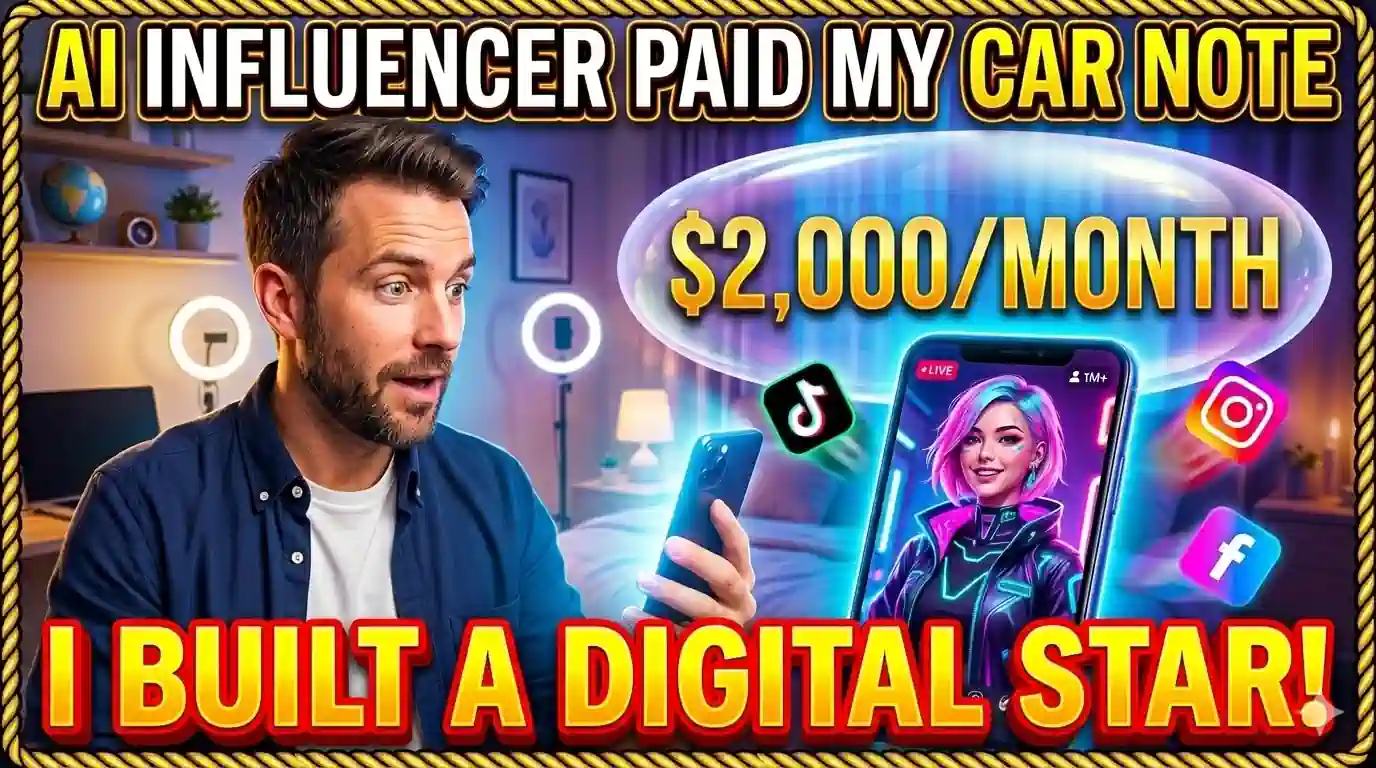
My $2,000-a-Month Digital Daughter: How I Built an AI Influencer That Pays My Car Note
.jpeg "Earn Passive Income with Wall Art")
I have a confession to make: my daughter is imaginary, and she’s currently supporting my family’s grocery habit.

Her name is Aria. She’s 23 years old, lives in Miami, works as a freelance graphic designer, and has a obsession with pastel-colored outfits and succulents she keeps killing. She has 47,000 followers on Instagram and TikTok. She’s never eaten a single meal, felt a single emotion, or taken a single breath.
And last month, she made me $2,048.
Let me back up, because I know how insane this sounds. Six months ago, I was a guy working overnight inventory at a warehouse, listening to podcasts to stay awake. One night, I stumbled onto an episode about the “virtual influencer economy.” They mentioned a character named Lil Miquela—a CGI influencer with millions of followers who collaborates with Prada and Calvin Klein . They talked about how major brands were pouring millions into partnerships with people who don’t exist.
I almost drove my forklift into a wall.
At first, I dismissed it as rich-people nonsense. But the idea wouldn’t leave me alone. I started researching and found stories that blew my mind: a 21-year-old college student created an AI influencer named “Gigi” over summer break and was making thousands from TikTok’s creator fund . A company in India built “Radhika Subramaniam,” an AI travel influencer, to promote tourism . This wasn’t science fiction anymore. It was happening, and regular people were cashing in.
The problem? I’m not tech-savvy. I can barely edit a photo on my phone. I needed someone to hold my hand through the process.
That’s when I found the course at xmoneyacademy.com/aiinfluencer. I almost didn’t click because I’d been burned by “get rich quick” garbage before. But the site felt different—it talked about “character consistency,” “algorithm psychology,” and “monetization funnels.” It sounded like a real business blueprint, not a miracle cure. I scraped together $197 from overtime shifts and took the plunge.
Best decision I ever made.
Week 1-2: Building Aria (The Creation Phase)
The course started with something I didn’t expect: psychology. Before generating a single image, I had to build a “character bible.” The instructor explained that people don’t follow influencers because they’re real—they follow because they’re aspirational or relatable . A generic pretty face gets scrolled past. A person with quirks gets followed.
So I created Aria on paper first. I gave her:
- A birthday (September 12, age 23)
- A backstory (grew up in Tampa, moved to Miami for art school)
- A personality (slightly sarcastic, perpetually running late, secretly a hopeless romantic)
- A pet (a virtual cat named “Mochi” who “hates everyone but her”)
- A style (pastels, oversized sweaters, thrifted sneakers)
The course provided templates for all of this. By the time I opened my first AI tool, I knew Aria better than I know some of my coworkers.
Then came the tech. The course pointed me to free and low-cost AI tools that had recently crossed what marketers call “the uncanny valley” —they were finally believable. Using prompt formulas from the course’s cheat sheets, I generated 100 images of Aria. I made sure every image had the same face structure, the same beauty mark near her left eye, the same wavy brown hair. Consistency was everything.
For video, I used animation tools that could make her nod, blink, and speak. The voice came from a text-to-speech service the course recommended—a warm, slightly playful voice with a hint of a Florida accent.
Week 3-4: The First Followers (The Growth Phase)
I launched Aria’s Instagram and TikTok accounts with exactly three posts: a “selfie” in a Miami coffee shop, a flat lay of her graphic design tools, and a video of her “complaining” about her cat knocking over a succulent.
The first week was crickets. Maybe 50 followers. I felt stupid.
But the course had prepared me for this. It emphasized that platforms like TikTok don’t care if a face is real or rendered—they care about retention and engagement . I needed to study trends and adapt them for Aria.
I started following the “Day in My Life” trend. I generated videos of Aria “waking up” (an AI-generated bedroom with sunlight streaming in), “walking to work” (AI-generated South Beach streets), and “grabbing coffee” (a perfectly rendered latte). I used trending audio. I engaged with every comment, even the ones accusing her of being fake.
Then, one video popped off. It was a POV video from her perspective—”When you’re a graphic designer and the client wants the logo bigger.” It was relatable, funny, and perfectly timed with a meme trend. Overnight, it hit 200,000 views.
By the end of month one, Aria had 8,000 followers.
Month 2: The First Dollar (The Monetization Phase)
The course’s “Monetization Matrix” module was worth the price alone. It laid out five ways to make money with an AI influencer, ranked by effort and payout. I attacked them one by one.
- TikTok Creator Fund: As Aria’s views crossed into the hundreds of thousands, the payouts started trickling in. It wasn’t huge—maybe $150 that month—but it was proof of concept. Just like the student who created “Gigi,” I was getting paid for views .
- Faceless YouTube Channel: The course suggested creating a second channel that used Aria’s image but wasn’t “her vlog.” I started posting “10 Graphic Design Tips for Beginners” videos with Aria as the narrator. These were easy to produce and designed for long-term ad revenue. It added another $200.
- The Big One—Brand Deals: A small jewelry brand based in Florida messaged Aria. They made handmade polymer clay earrings and loved her “Miami aesthetic.” They offered $150 for a post. I almost screamed. Using the course’s negotiation templates, I countered with $300 for a package of three photos. They accepted.
I didn’t need to ship jewelry. I didn’t need to do a photoshoot. I generated images of Aria wearing their earrings (digitally recreated from their website photos) in various Miami-inspired settings. The brand was thrilled. I was hooked.
Month 3-6: Scaling to $2,000
That first brand deal opened the floodgates. Once you have one client, the course taught me how to leverage it to get more. I built a simple media kit using Canva (another course recommendation) that presented “Aria” as a media property with engagement rates and demographics.
By month six, here’s where the $2,000 came from:
- Brand Partnerships ($1,200): I landed two consistent brand partners—a small activewear company and a vegan skincare line. They paid monthly retainers for a set number of posts. I also did one-off deals with local Miami cafes and boutique hotels, who loved the idea of “digital ambassadorship.”
- TikTok Creator Fund & YouTube AdSense ($500): As Aria’s library of content grew, so did the passive income. Old videos kept getting views, especially the “timeless” content like design tutorials.
- Fanvue/Subscription Content ($300): The course recommended creating a “private” page for Aria’s most dedicated followers. I posted exclusive “behind-the-scenes” content (which was just me explaining my process) and extra photos. A small but loyal group paid for access.
The Reality Nobody Talks About
It hasn’t been all smooth sailing. I’ve dealt with people in comments calling Aria “creepy” or accusing me of deception. I’ve spent hours troubleshooting why an AI generator gave her three hands or a melting face. I’ve wrestled with the weird ethics of it all, remembering the backlash Lil Miquela faced when she “came out” as an AI activist .
But I’ve also watched my savings account grow. I’ve paid off my car. I’ve taken my family to dinner without checking my bank balance first. Aria, my imaginary digital daughter, has done more for my financial stability in six months than my warehouse job did in three years.
The course at xmoneyacademy.com/aiinfluencer gave me more than just technical instructions. It gave me confidence. It gave me a roadmap when I felt lost. It took this massive, intimidating concept and broke it into bite-sized, achievable steps.
Last week, I walked past a magazine stand and saw a human influencer on the cover of a fashion magazine. A few years ago, I would have thought, “Must be nice to be born that lucky.”
Now? I think, “I wonder if Aria could get a cover like that someday.”
She probably could. She’s whatever I want her to be. And that’s the most powerful realization I’ve ever had.
If you’re curious about the AI space but don’t know where to start—if you’re sitting there thinking this sounds like science fiction—just know that six months ago, I was you. I was a skeptical warehouse worker with a dream and a lot of self-doubt.
The only difference is, I clicked the link.
xmoneyacademy.com/aiinfluencer
It might just change your life too. It changed mine.