
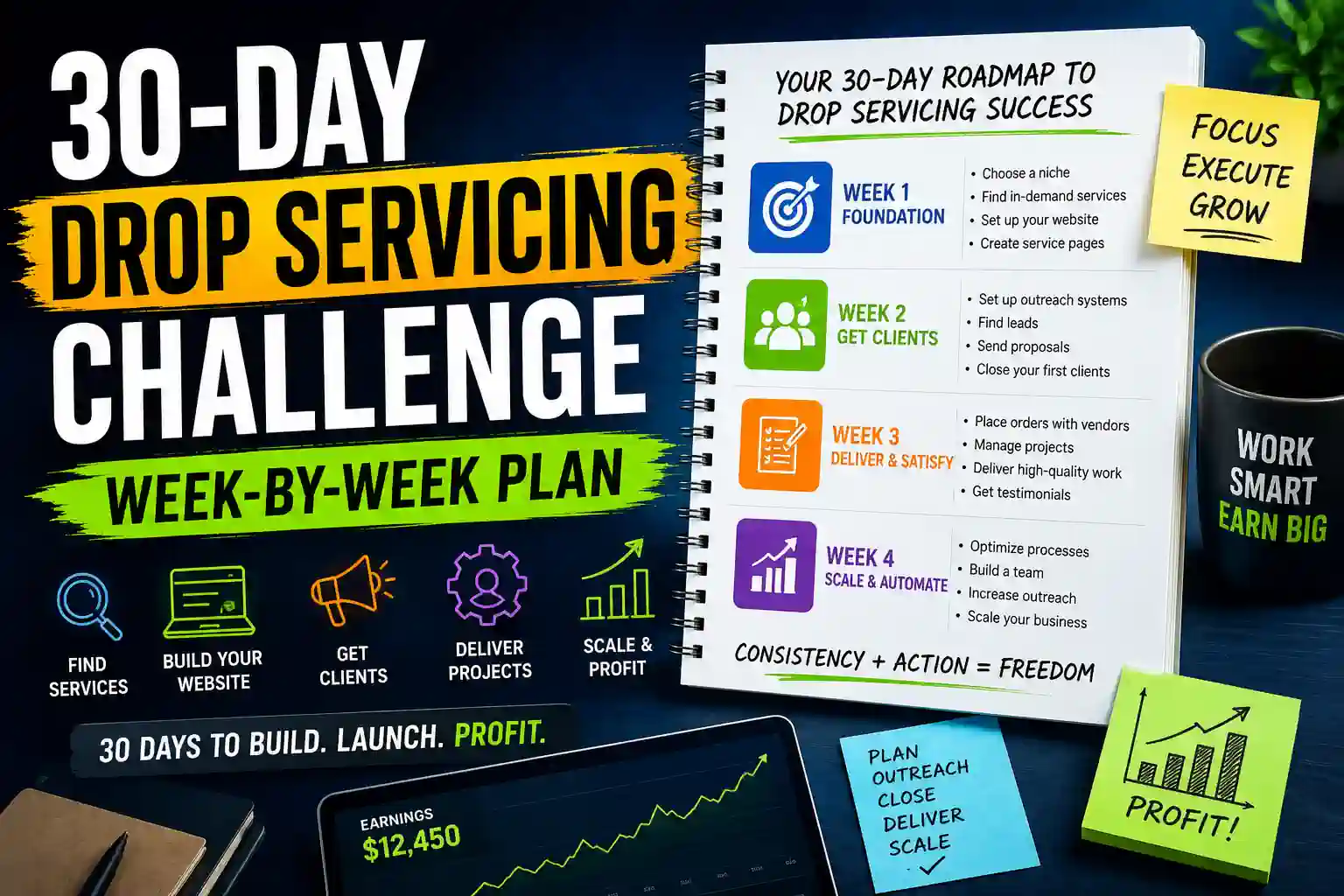
30-day drop servicing challenge: week-by-week plan
Table of Contents
.jpeg "Earn Passive Income with Wall Art")
Starting a new business often feels overwhelming, but you do not have to navigate the digital marketplace alone. Our 30-day drop servicing challenge: week-by-week plan provides a clear, actionable roadmap designed to help you launch your venture with confidence.

We break down complex tasks into manageable steps that keep you focused from your first day to your final goal. By following this structured approach, you will avoid common mistakes that often hinder new entrepreneurs.

30-day drop servicing challenge: week-by-week plan
This guide is crafted to help you maximize your potential for early revenue generation. Whether you are a beginner or looking to refine your process, these insights will keep you on track toward building a successful service-based business.
Key Takeaways
- Follow a structured timeline to launch your business in one month.
- Break down complex operations into simple, daily tasks.
- Identify and avoid common pitfalls that stall new entrepreneurs.
- Focus on strategies that prioritize early revenue generation.
- Gain the confidence needed to compete in the digital marketplace.
Understanding the Drop Servicing Business Model
The beauty of the drop servicing business model lies in its simplicity and its ability to scale without needing a massive inventory. At its heart, this approach functions much like traditional dropshipping, but it focuses entirely on digital deliverables rather than physical goods.
Defining the core concept
In this model, you act as the professional intermediary between clients who need specific tasks completed and skilled freelancers who perform the actual work. You secure the client, manage the project requirements, and then outsource the execution to a qualified professional.
This structure allows you to maintain a lean operation while providing high-quality results to your customers. You are essentially building a bridge between demand and supply, ensuring that both parties achieve their goals through your coordination.
“The secret of business is to know something that nobody else knows.”
— Aristotle Onassis
Why drop servicing is ideal for beginners
If you are researching how to start drop servicing, you will quickly find that it requires minimal upfront capital. Unlike starting a traditional agency that requires expensive software or a large team, you can begin with just a website and a network of reliable freelancers.
This model allows you to focus entirely on sales, marketing, and project management. By removing the need to perform the technical labor yourself, you gain the freedom to scale your business rapidly as your client base grows.
| Feature | Traditional Agency | Drop Servicing |
|---|---|---|
| Upfront Costs | High | Low |
| Technical Skill | Required | Not Required |
| Scalability | Limited by time | Highly scalable |
| Primary Focus | Execution | Sales & Management |
Learning how to start drop servicing effectively is the first step toward building a sustainable and profitable online venture. By mastering these fundamentals, you position yourself to succeed in a competitive digital marketplace without the typical overhead burdens.
Week One: Niche Selection and Market Research
Mastering the art of niche selection is the most critical step when you learn how to start drop servicing. During these first seven days, your primary goal is to identify a profitable area that balances high demand with manageable competition. By focusing your energy here, you set a solid foundation for long-term growth.
Identifying high-demand service categories
To succeed, you must look for high-demand service categories where businesses are willing to pay for quality results. Think about tasks that companies struggle to handle in-house, such as technical writing, video editing, or specialized graphic design. These areas often provide the best margins for your business.
You should prioritize services that offer recurring needs rather than one-off projects. This approach ensures a more stable income stream as you scale your operations. Always look for gaps in the market where you can provide superior project management.
Analyzing competitor pricing and offerings
Once you have a list of potential services, it is time to look at what others are doing. Analyzing competitor pricing helps you understand the current market standard for your chosen field. You want to position your brand as a premium provider that delivers exceptional value rather than just the cheapest option.
Take note of the specific packages your competitors offer to their clients. By identifying what they might be missing, you can create a unique selling proposition that attracts your ideal customers. This research phase is essential for building a competitive edge.
| Service Category | Market Demand | Competition Level | Profit Potential |
|---|---|---|---|
| Content Writing | High | Moderate | Medium |
| Video Editing | Very High | High | High |
| Social Media Management | High | High | Medium |
| Technical SEO | High | Low | Very High |
Validating your chosen niche
Before you invest time in building your infrastructure, you must validate that there is a real market need. You can do this by checking search volume trends or engaging with potential clients in online forums. This simple step prevents you from wasting resources on a niche that lacks paying customers.
Remember that knowing how to start drop servicing effectively requires patience and data-driven decisions. If you find that your chosen high-demand service categories are too saturated, do not be afraid to pivot early. Validation is your safety net in this competitive digital landscape.
Week Two: Building Your Professional Service Website
Now that you have a niche, it is time to build a service website that converts visitors into paying clients. This digital storefront serves as the face of your business and dictates how potential customers perceive your brand. Taking the time to build a service website that looks professional is a vital investment in your long-term success.
Choosing the right platform for your store
Selecting the right technology stack is the first step in your journey. You do not need to be a coding expert to create a high-performing site in today’s market. Platforms like Shopify, WordPress, or Wix offer intuitive drag-and-drop tools that make it easy to build a service website without technical headaches.
Consider your budget and the specific features you need before committing to a platform. Most modern builders provide templates specifically designed for service-based businesses. These templates often include pre-built layouts that help you get up and running within a few days.
Designing for trust and conversion
Clients need to feel confident in your ability to deliver results before they commit to a purchase. A cluttered or outdated design can quickly drive potential leads away. Focus on a clean, minimalist aesthetic that highlights your value proposition immediately upon landing on your page.
Use high-quality imagery and clear, concise language to communicate your services. Trust signals, such as professional branding and fast loading speeds, are essential for maintaining credibility. When your site looks polished, visitors are much more likely to trust you with their business needs.
Essential pages every service site needs
To ensure your site functions effectively, you must include specific pages that guide the user journey. Every professional site should feature the following core components:
- Home Page: A clear summary of what you offer and why it matters.
- Services Page: Detailed descriptions of your offerings with transparent pricing.
- About Page: Your brand story to build a personal connection with your audience.
- Contact Page: Simple forms or direct links to reach your team.
- Social Proof: Testimonials or case studies that validate your expertise.
By organizing these pages logically, you create a seamless experience for your visitors. Remember that your goal is to make the path to purchase as simple and intuitive as possible.
Week Three: Sourcing Reliable Service Providers
Success in drop servicing relies heavily on the quality of the contractors you bring on board. Your reputation depends entirely on the final output delivered to your clients. Therefore, you must prioritize building a network of experts who consistently meet your standards.
Where to find high-quality freelancers
To find reliable freelancers, you should look toward established digital marketplaces. Platforms like Upwork and Fiverr offer massive pools of talent across every imaginable niche. LinkedIn is another powerful tool for connecting with specialized professionals who may not be on traditional gig sites.
When searching, look for individuals who have a history of long-term projects. Consistency is key when you are building a scalable business model. You want partners who treat your projects with the same care as their own.
| Platform | Best For | Vetting Level |
|---|---|---|
| Upwork | Long-term contracts | High |
| Fiverr | Quick, specific tasks | Medium |
| Niche experts | High |
Vetting providers for quality and reliability
Implementing a rigorous freelance service vetting process is essential to filter out unreliable contractors. Start by reviewing their portfolios to ensure their past work matches the quality you promised your clients. Never skip the step of requesting a small, paid test task before committing to a larger project.
Communication during the interview phase is a major indicator of future performance. If a freelancer is slow to respond or fails to ask clarifying questions, they may not be the right fit. Trust your instincts when evaluating potential partners during this stage.
Establishing communication and workflow protocols
Once you have selected your team, you must establish clear communication and workflow protocols. Using tools like Slack or Trello helps keep everyone on the same page. You should provide detailed project briefs that outline every expectation, deadline, and deliverable format.
By setting these standards early, you ensure that your team understands exactly what is required for every order. This proactive approach helps you find reliable freelancers who grow with your business. Effective freelance service vetting and clear management are the foundations of a sustainable, profitable venture.
Executing the 30-day drop servicing challenge: week-by-week plan
Mastering the execution phase is essential for anyone following a 30-day drop servicing challenge: week-by-week plan. Moving from the initial setup to active operations requires a shift in mindset toward consistent, daily action. By breaking your goals into manageable parts, you ensure that your business gains momentum without overwhelming your schedule.
Setting daily milestones for success
To stay on track, you must prioritize tasks that directly impact your bottom line. Instead of getting lost in minor design tweaks, focus your energy on revenue-generating activities like outreach and client communication. Setting clear, bite-sized goals for each day keeps you accountable and prevents the feeling of being stuck.
Try to dedicate at least two hours every morning to high-priority tasks. When you complete these milestones, you build the confidence needed to scale your operations effectively. Remember that small, steady wins are the foundation of a sustainable business model.
Tracking progress and adjusting strategies
Data is your best friend during this 30-day journey. By keeping a simple log of your daily outreach efforts and conversion rates, you can quickly identify which tactics are working. If a specific marketing channel isn’t yielding results, do not hesitate to pivot your approach.
Flexibility is a superpower for new entrepreneurs. Use your tracking data to refine your messaging or target a slightly different audience segment. This iterative process ensures that your 30-day drop servicing challenge: week-by-week plan remains effective even when market conditions shift.
Overcoming common early-stage hurdles
It is completely normal to face obstacles during your first month of operation. Many entrepreneurs struggle with self-doubt or the fear of rejection when reaching out to potential clients. You can overcome these hurdles by viewing every “no” as a valuable learning opportunity rather than a personal failure.
Maintain your motivation by connecting with your long-term vision whenever you feel discouraged. Surround yourself with positive resources and stay focused on the progress you have already made. By staying resilient, you will navigate the initial challenges and emerge with a stronger, more profitable business.
Developing Your Pricing Strategy
Mastering your drop servicing pricing strategy is the key to long-term sustainability. Without a clear plan, you risk losing money on every project once you account for freelancer fees and operational costs. A well-structured approach ensures that your business remains profitable while providing real value to your customers.

Calculating your profit margins
To calculate your margins, you must look beyond the base cost of the service. You need to subtract all expenses, including platform transaction fees, marketing spend, and the actual payment to your freelancer. Accuracy is vital here to ensure you are not working for free.
Always build a buffer into your pricing to cover unexpected revisions or communication time. If a freelancer charges $100, you should aim to sell that service for at least $200 to $250. This margin covers your overhead and rewards you for the time spent managing the client relationship.
Tiered pricing models for different client needs
Implementing tiered pricing allows you to capture a wider range of clients. By offering different levels of service, you cater to both budget-conscious startups and established enterprises. This strategy helps you maximize revenue by providing options that fit various budgets.
| Service Tier | Target Audience | Value Proposition | Profit Potential |
|---|---|---|---|
| Basic | Startups | Essential features | Moderate |
| Standard | Growing Businesses | Full service + support | High |
| Premium | Enterprises | Priority + custom work | Very High |
Handling payment processing and invoicing
Reliable payment processing is the backbone of your drop servicing pricing strategy. You should use professional tools like Stripe or PayPal to ensure transactions are secure and fast. These platforms provide automated invoicing, which saves you time and reduces the risk of human error.
Always send invoices immediately upon project milestones or completion to maintain healthy cash flow. Clear payment terms help you avoid awkward conversations and ensure you get paid promptly for your hard work. Professionalism in billing builds trust and encourages clients to return for future projects.
Crafting High-Converting Sales Copy
Your words are the bridge between a casual visitor and a loyal, paying client. When you build a service website, the text on your pages serves as your primary salesperson. It must communicate value clearly and quickly to capture interest before a user clicks away.
Writing compelling service descriptions
Many beginners make the mistake of listing only technical features. Instead, focus on the transformative benefits your service provides to the customer. Ask yourself how your work solves a specific pain point or improves their daily life.
Use clear, benefit-driven language to explain your value proposition. For example, rather than saying “I write 500 words,” say “I create engaging blog posts that help you rank higher and attract more customers.” This shift in perspective makes your offer much more attractive.
Using psychological triggers to drive sales
To generate high-converting sales copy, you must tap into human psychology. People often hesitate to make decisions unless they feel a sense of urgency or exclusivity. You can encourage action by using specific, proven triggers:
- Scarcity: Mention limited availability for your monthly service slots.
- Social Proof: Highlight testimonials or case studies to build instant trust.
- Urgency: Offer a time-sensitive bonus for clients who book within the next 24 hours.
These elements create a compelling reason for a visitor to stop browsing and start buying. Emotional connection is just as important as logic when closing a deal.
Optimizing content for search engines
Even the best copy will not perform well if nobody finds your site. You must optimize your text so that search engines understand exactly what you offer. Start by researching the specific terms your target audience uses when they search for help.
Incorporate these keywords naturally into your headings, meta descriptions, and body text. Avoid stuffing keywords, as this hurts your readability and search rankings. Focus on providing valuable, helpful content that answers the questions your potential clients are asking.
Implementing Your Marketing Strategy
Launching your site is just the first step toward building a profitable service business. Once your platform is live, you must pair your high-converting sales copy with a proactive plan to attract your target audience. Effective promotion ensures that your services reach the people who need them most.
Leveraging social media for organic reach
Social media offers a powerful way to build a community around your specific niche. Instead of just posting ads, focus on sharing valuable insights that solve common problems for your potential clients. By engaging consistently, you establish authority and trust within your industry.
Choose platforms where your ideal customers spend their time, such as LinkedIn for B2B services or Instagram for creative work. Consistency is key to growing an organic following that eventually converts into paying clients.
Utilizing cold outreach techniques
Cold outreach allows you to connect directly with prospects who are actively seeking solutions. Start by identifying businesses or individuals that align with your service offerings. Send personalized messages that highlight how your expertise can solve their specific pain points.
Avoid generic templates that feel like spam. Instead, focus on building a genuine connection by showing that you have researched their needs. This direct approach often yields faster results than waiting for organic traffic to build up.
Exploring paid advertising options
Once you have a proven offer and a healthy budget, paid advertising can help you scale your reach quickly. Platforms like Google Ads or Meta Ads allow you to target specific demographics with precision. This ensures your budget is spent on reaching people who are most likely to purchase your services.
Start with a small test budget to see which ads perform best before scaling up. Mastering digital marketing for services through paid channels is a reliable way to maintain a steady flow of leads as your business grows.
Managing Client Relationships and Expectations
Building a sustainable business requires more than just finding clients; it demands mastery of client relationship management. When you treat every interaction with care, you transform one-time buyers into repeat customers who provide steady, predictable revenue. This focus on connection helps you move away from the constant stress of lead generation.

Setting clear project timelines
Transparency is the foundation of trust in any service-based business. You must provide your clients with a clear roadmap that outlines exactly what to expect and when to expect it. Never leave your customers guessing about the status of their orders.
- Provide an estimated delivery date immediately after purchase.
- Send automated updates when milestones are reached.
- Proactively communicate if a delay occurs to maintain credibility.
Handling feedback and revisions professionally
Receiving feedback is a natural part of the process, even when your drop servicing pricing strategy is perfectly aligned with market expectations. How you respond to these requests defines your reputation in the industry. Always approach revisions with a calm, solution-oriented mindset rather than taking them personally.
When a client asks for changes, view it as an opportunity to refine your service delivery. By documenting these requests, you can provide better instructions to your freelancers in the future. This cycle of improvement ensures that your final output consistently meets high standards.
Building long-term client loyalty
Loyalty is earned through consistent performance and genuine care for the client’s success. When you deliver high-quality work on time, you create a sense of reliability that is hard to find elsewhere. Clients who feel valued are far more likely to return for additional services or refer your business to others.
Consider implementing a simple follow-up process to check in on your clients after a project is complete. A quick email asking if they are satisfied can go a long way in building a lasting partnership. Prioritizing these relationships will ultimately create a more stable and profitable business model for your long-term success.
Scaling Your Operations for Growth
Transitioning from a solo side hustle to a full-scale agency requires a shift in your operational mindset. You must move away from doing every task yourself and start building systems that allow your business to thrive independently. This transition is the key to long-term success in the competitive landscape of the United States.
Automating repetitive business tasks
To scale your service business effectively, you must embrace service business automation. By using tools for invoicing, project tracking, and client communication, you free up valuable hours for high-level strategy. When you remove manual bottlenecks, you can focus on scaling rather than just maintaining the status quo.
“Systems allow ordinary people to achieve extraordinary results predictably.”
— Michael Gerber
Consider the following comparison to see how automation changes your daily workflow:
| Task | Manual Approach | Automated Approach |
|---|---|---|
| Invoicing | Manual PDF creation | Recurring billing software |
| Project Tracking | Spreadsheets | Project management platforms |
| Client Updates | Individual emails | Automated status notifications |
Expanding your service catalog
Once your core operations are stable, look into high-demand service categories to broaden your reach. Expanding your catalog allows you to offer more value to existing clients while tapping into new market segments. You might consider adding digital marketing for services or specialized consulting to your current offerings to increase your average order value.
Hiring additional support staff
Eventually, you will reach a point where your own time is the biggest constraint on your service business growth. Bringing on virtual assistants or specialized freelancers helps you manage the increased workload without sacrificing quality. Effective service business automation combined with a reliable team creates a powerful engine for your agency’s future.
Common Pitfalls and How to Avoid Them
Avoiding common drop servicing pitfalls is the secret to building a sustainable and profitable agency. While the drop servicing business model offers incredible flexibility, it requires a sharp eye for detail to ensure your clients remain satisfied.
Managing quality control issues
The biggest risk to your reputation is delivering subpar work. To mitigate this, you must implement a strict review process before any project reaches the client.
When you find reliable freelancers, you create a foundation for success. However, never skip the freelance service vetting phase. Always request samples and conduct small test projects to ensure their output meets your high standards.
Dealing with communication breakdowns
Effective client relationship management relies on transparency and clear documentation. If you fail to track project requirements, misunderstandings will inevitably occur.
Keep all project details in a centralized hub that both you and your team can access. Proactive updates prevent panic and build trust with your customers.
“Success is not final, failure is not fatal: it is the courage to continue that counts.”
Winston Churchill
Staying motivated during the first month
The first thirty days are often the most difficult for new business owners. You might face slow growth or technical hurdles that test your resolve.
- Celebrate small wins to maintain your momentum.
- Focus on long-term goals rather than daily fluctuations.
- Connect with other entrepreneurs to share experiences and advice.
Remember that persistence is your greatest asset. By staying organized and keeping your eyes on the prize, you will overcome the initial learning curve and thrive.
Conclusion
The 30-day challenge offers a clear path to building a profitable online venture. You now possess the tools to navigate the market and launch your brand with confidence.
Success requires a commitment to avoiding common drop servicing pitfalls. By staying alert to quality control and communication, you protect your reputation and client trust.
You should prioritize service business automation to save time as your orders increase. This shift allows you to focus on high-level strategy rather than repetitive manual tasks.
Consistent effort remains the primary driver for your long-term service business growth. Every small win builds momentum toward a sustainable and lucrative career.
You have the power to scale your service business to new heights starting right now. Take the first step today and transform your professional future through these proven methods.
FAQ
What exactly is the drop servicing business model and why is it popular?
A: Drop servicing functions very similarly to dropshipping, but instead of physical products, you focus on selling digital services. You act as the professional intermediary between clients who need specific tasks completed and skilled freelancers who perform the work. It is ideal for beginners because it requires minimal upfront capital and allows you to focus your energy on sales, branding, and project management rather than technical fulfillment.
How do I choose a profitable niche during the first week of the challenge?
During Week One, your goal is to identify a high-demand service category, such as SEO auditing, copywriting, or social media management. You should conduct market research by analyzing competitor pricing on platforms like Upwork or Fiverr. Validating your niche ensures there is a real market need before you invest time into building your digital storefront.
What platforms are best for building my service website in Week Two?
To build a professional service website, many entrepreneurs turn to user-friendly platforms like Shopify, WordPress (using Elementor), or Wix. The key is to design for trust and conversion by including essential pages like clear service descriptions, social proof, and easy-to-use contact forms to capture leads effectively.
Where can I find high-quality freelancers to fulfill my orders?
You can source top-tier talent on reputable platforms such as Fiverr Pro, Upwork, and Toptal. During Week Three, it is vital to implement a rigorous freelance service vetting process to ensure your providers are reliable. Establishing clear workflow protocols from the start helps maintain quality and prevents communication breakdowns.
How should I calculate my profit margins to ensure the business is sustainable?
To develop a winning pricing strategy, you must calculate profit margins by subtracting the freelancer’s fee, platform transaction costs (like those from Stripe or PayPal), and marketing expenses from your total sale price. Offering tiered pricing models allows you to cater to different budgets, from small startups to larger enterprises.
What is the best way to drive traffic to my new business in the first month?
A robust marketing strategy should involve a mix of organic reach and direct outreach. You can leverage LinkedIn for cold outreach to connect with B2B clients or use Facebook Ads and Google Ads for immediate visibility. Additionally, optimizing content for search engines (SEO) will help you attract long-term organic traffic.
How do I handle client revisions and feedback without losing money?
Managing client relationships effectively requires setting clear project timelines and defining the number of included revisions upfront. By handling feedback professionally and acting as a bridge between the client and the freelancer, you can ensure a high-quality result that builds long-term client loyalty.
Can I automate the drop servicing process as the business grows?
Absolutely! Scaling your operations involves implementing service business automation tools. You can use software like Trello or Asana for project tracking and QuickBooks for automated invoicing. As you experience consistent service business growth, you may eventually hire a virtual assistant to manage daily communications.
What are the most common pitfalls to avoid during the 30-day challenge?
Many new owners struggle with quality control issues or lose motivation if they don’t see an immediate sale. To avoid these, implement a strict review process before delivering work and set daily milestones to track your progress. Staying focused on revenue-generating activities rather than minor website tweaks is the key to completing the 30-day drop servicing challenge successfully.