
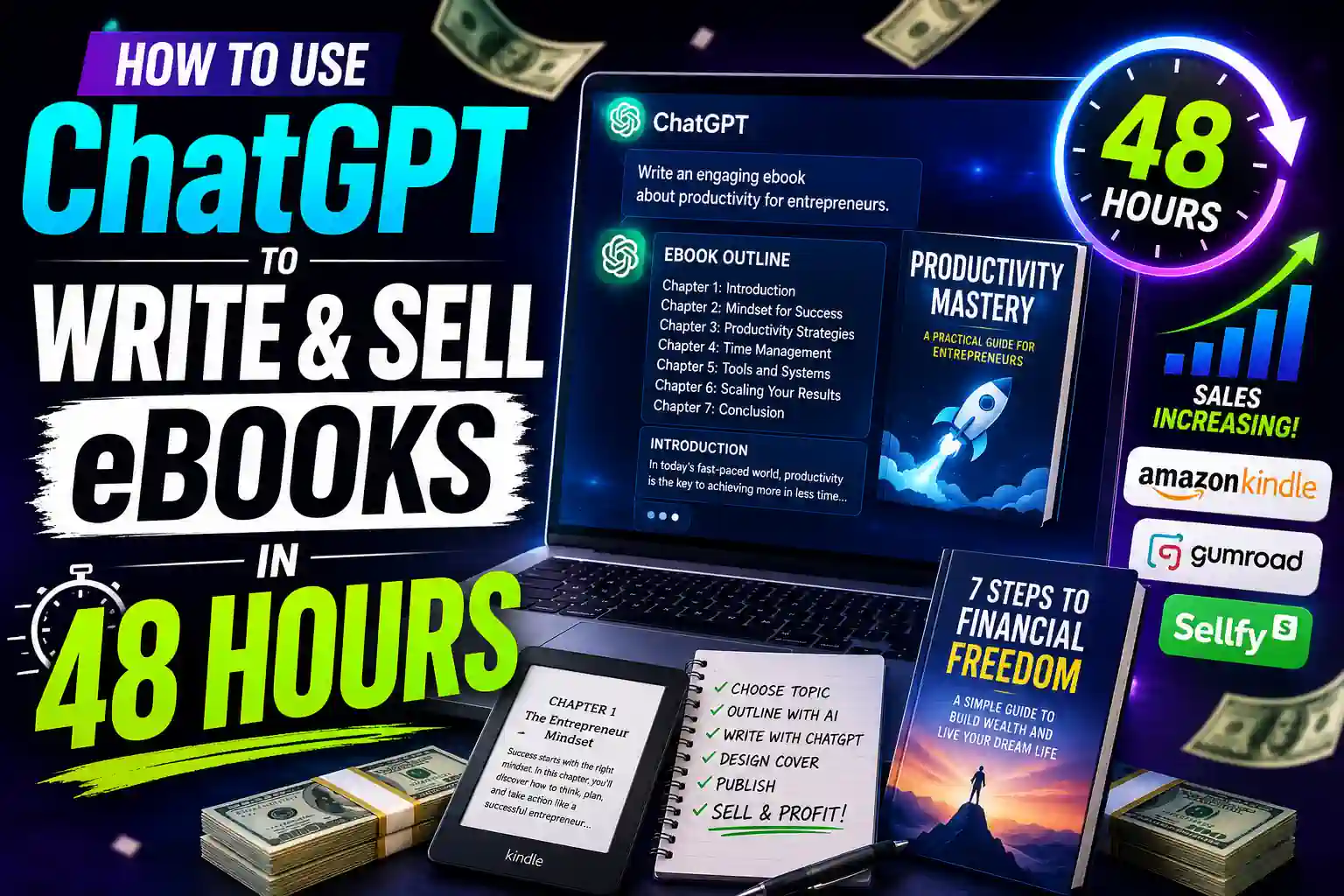
How to use ChatGPT to write and sell ebooks in 48 hours
Table of Contents
.jpeg "Earn Passive Income with Wall Art")
The digital publishing landscape is shifting rapidly. Today, artificial intelligence offers a transformative path for creators who want to bypass traditional gatekeepers. You can now master How to use ChatGPT to write and sell ebooks in 48 hours by leveraging smart automation tools.

This guide focuses on a structured 48-hour ebook sprint. By breaking your project into manageable phases, you maintain high momentum from the initial idea to the final sale. This method ensures your content remains polished while you achieve your goals at record speed.

Embracing Fast ebook publishing allows you to stay competitive in a crowded market. You no longer need months of preparation to launch a professional product. Follow these steps to streamline your workflow and start generating revenue immediately.
Key Takeaways
- Leverage AI to accelerate your writing process significantly.
- Adopt a strict 48-hour timeline to maintain creative focus.
- Streamline every phase from brainstorming to final distribution.
- Bypass traditional publishing delays with modern digital tools.
- Maintain high quality while working at an accelerated pace.
Selecting a Profitable Niche and Topic
Selecting a profitable ebook niche is the secret weapon behind every successful digital product. Your choice of subject dictates your target audience and determines your long-term revenue potential. By focusing on the right area, you can ensure your work reaches people who are eager to buy.
AI ebook writing tools have revolutionized how creators find their footing in a crowded market. These platforms allow you to analyze vast amounts of data to uncover gaps that others have missed. When you align your passion with market needs, you create a foundation for consistent sales.
Identifying High-Demand Subjects
To find high-demand ebook topics, you should look for areas where people are actively seeking solutions to specific problems. Start by exploring categories on platforms like Amazon Kindle or Goodreads to see what is currently trending. If you notice a high volume of recent releases in a specific category, it is a strong indicator of reader interest.
You can use AI to brainstorm sub-niches that are underserved. For example, instead of writing a broad book on fitness, you might focus on “post-partum strength training for busy mothers.” This specific approach helps you stand out in profitable ebook niches while providing immense value to a targeted group.
Validating Your Idea with Market Research
Before you commit to a project, you must validate your concept through thorough market research. You do not want to spend hours writing a book that nobody wants to read. Data-driven decisions are the key to minimizing risk and maximizing your return on investment.
Consider these simple methods to verify your idea:
- Check Google Trends to see if search interest for your topic is stable or growing.
- Review the “Most Wished For” lists on major retail sites to identify unmet needs.
- Engage with online communities on Reddit or Facebook to see what questions people are asking.
By using AI ebook writing to synthesize this research, you can quickly confirm if there is a hungry audience waiting for your content. Validating your high-demand ebook topics early ensures that your 48-hour sprint results in a product that actually sells.
Structuring Your Ebook Outline with ChatGPT
Building a successful ebook starts with a clear and logical roadmap. A well-structured outline is essential for maintaining focus and ensuring your book provides genuine value to the reader. By organizing your thoughts early, you avoid the common trap of getting lost in your own narrative.
Prompting for a Comprehensive Table of Contents
When you use ChatGPT for authors, you can generate a detailed table of contents in seconds. Start by providing the AI with your core topic and target audience. Ask the tool to suggest ten to twelve chapters that cover the subject from start to finish.
Effective prompts are the key to getting high-quality results. Instead of asking for a simple list, request a breakdown that includes specific subtopics for each chapter. This approach ensures that your final product is comprehensive and covers all necessary ground for your readers.
Refining Chapter Flow for Reader Engagement
Once you have a draft, it is time to focus on the logical progression of your ideas. Writing ebooks with AI becomes much easier when you treat the outline as a living document. You should review the sequence to ensure that each section leads naturally into the next, creating a smooth experience for your audience.
Mastering AI prompt engineering for writers allows you to ask the AI to identify gaps in your logic. You can prompt the system to suggest transitions or to reorder chapters for better pacing. By refining your structure before you begin drafting, you create a robust framework that makes the entire writing process a seamless and efficient journey.
Drafting Content Using Strategic Prompts
Mastering the art of AI prompt engineering for writers will change how you approach your next project. By breaking your manuscript into manageable pieces, you ensure that the final product remains coherent and professional. This method allows you to maintain high standards while accelerating your production timeline.
Writing Chapter by Chapter for Consistency
When you focus on one chapter at a time, you avoid the common pitfalls of disjointed narratives. Automated content creation works best when you provide specific context for each section. This granular approach helps the AI stay focused on the unique goals of every chapter.
Consider the following comparison of manual versus AI-assisted drafting methods to see how your workflow improves:
| Feature | Manual Writing | AI-Assisted Drafting |
|---|---|---|
| Speed | Slow and steady | Rapid production |
| Consistency | Hard to maintain | High with prompts |
| Editing Time | Moderate | Minimal |
Maintaining a Consistent Tone and Voice
Your brand identity relies on a steady voice that resonates with your target audience. Writing ebooks with AI requires you to define your tone clearly in your initial instructions. If you want a friendly or authoritative tone, state this explicitly to keep the output aligned with your vision.
“The secret to great writing is not just the words you choose, but the consistency of the voice that delivers them.”
— Anonymous Author
Adjusting Style Settings in ChatGPT
You can refine your results by adjusting style settings within your prompts. Use specific descriptors like “conversational,” “professional,” or “persuasive” to guide the AI. This simple step ensures that your AI ebook writing process yields a polished manuscript that sounds like it came from a single, expert source.
Ensuring Logical Transitions Between Sections
Logical flow is essential for keeping readers engaged from the first page to the last. Always ask the AI to summarize the previous chapter before starting a new one. This technique creates a natural bridge between ideas, making your automated content creation feel seamless and human-like.
By implementing these strategies, you will find that writing ebooks with AI is not only efficient but also highly rewarding. Stay focused on your structure, and your readers will appreciate the smooth, professional journey you have created for them.
Editing and Polishing Your Manuscript
Even the best AI-generated drafts require a human touch to truly shine. While technology provides a fantastic foundation, your unique perspective is what connects with readers on a deeper level. By combining your creative vision with AI-assisted editing, you can produce a manuscript that feels both professional and authentic.

Using ChatGPT for Grammar and Clarity Checks
You can leverage ChatGPT for authors to act as a tireless proofreader. Simply paste your chapters into the interface and ask the tool to identify passive voice, run-on sentences, or awkward phrasing. This process helps you tighten your prose and ensures your message remains clear throughout the book.
Consistency is key when writing for a specific audience. Use the tool to check if your tone remains steady from the first page to the last. If a section feels too robotic, ask the AI to rewrite it with a more conversational or authoritative flair.
Fact-Checking and Adding Personal Insights
Never rely solely on software for factual accuracy. Always verify statistics, dates, and historical claims against reliable primary sources. ChatGPT for authors is a powerful assistant, but it can occasionally hallucinate information, so your verification is essential for building trust.
To make your book stand out, inject your own stories and experiences into the text. AI cannot replicate your personal journey or the specific lessons you have learned in your career. Adding these human elements transforms a generic guide into a valuable resource that readers will cherish.
| Task | AI Responsibility | Human Responsibility |
|---|---|---|
| Grammar | Identifying errors | Final approval |
| Tone | Suggesting style | Setting the voice |
| Facts | Drafting content | Verifying accuracy |
| Insights | Structuring ideas | Adding personal stories |
Designing an Eye-Catching Cover
Your book cover acts as the silent salesperson for your digital product. In the fast-paced world of digital product creation, the visual presentation of your work is often the deciding factor for a potential reader. A polished, professional look builds immediate trust and signals that your content is worth their time.
Leveraging AI Tools for Visual Assets
You no longer need to hire a high-end designer to produce a high-quality cover. Modern ebook cover design tools allow you to generate stunning imagery and layouts in minutes. By using AI-powered platforms, you can transform simple concepts into professional assets that compete with major publishing houses.
Consider these popular options to streamline your design workflow:
- Canva: Offers intuitive drag-and-drop features with AI-enhanced templates.
- Midjourney: Perfect for generating unique, high-resolution artistic backgrounds.
- Adobe Express: Provides professional-grade typography and layout tools for quick edits.
“Design is not just what it looks like and feels like. Design is how it works.”
— Steve Jobs
Creating Professional Titles and Subtitles
A great cover is only half the battle; your text must also command attention. Your title should be clear, bold, and easy to read even as a small thumbnail on a mobile screen. Using effective ebook cover design tools, you can experiment with font pairings that highlight your main value proposition.
Focus on these strategies to craft a winning title:
- Keep it concise: Aim for a title that can be read in under two seconds.
- Use a descriptive subtitle: Explain exactly what the reader will gain or learn.
- Contrast is key: Ensure your text color stands out against the background image.
Remember that clarity always beats cleverness when it comes to selling digital products. By combining a striking visual with a compelling, readable title, you significantly increase your chances of turning a casual browser into a loyal reader.
Formatting Your Ebook for Digital Platforms
Proper formatting is the secret ingredient that turns a simple document into a professional ebook. When you prioritize professional ebook formatting, you ensure that your content remains readable and visually appealing across all devices. This step is crucial for fast ebook publishing, as it prevents technical delays during the submission process.
Converting Text to EPUB and PDF Formats
To reach the widest audience, you must provide your book in the correct file types. EPUB is the industry standard for most digital platforms because it allows text to reflow based on the user’s screen size. Meanwhile, PDF files are excellent for maintaining a fixed layout, which is often preferred for books with many images or complex charts.
You can use various tools to convert your manuscript quickly. Many authors find success with these methods:
- Calibre: A powerful, free tool for managing and converting ebook files.
- Draft2Digital: Offers automated conversion services that handle the technical heavy lifting for you.
- Google Docs/Word Export: Simple built-in features that allow you to save your work as a clean PDF.
Optimizing Layouts for Kindle and Mobile Devices
Readers today consume content on a variety of screens, ranging from small smartphones to large tablets. Formatting ebooks for mobile requires a focus on simplicity and clean design. Avoid using overly complex tables or nested images that might break when the screen size changes.
When preparing your files, keep these Kindle direct publishing tips in mind to ensure a smooth experience:
- Use standard fonts that are easy to read on low-resolution screens.
- Ensure your chapter headings are clearly defined using H1 or H2 tags for easy navigation.
- Test your file on a Kindle Previewer tool to see exactly how the text appears to your readers.
By following these steps, you create a seamless reading experience that encourages positive reviews. A well-formatted book reflects your commitment to quality and helps your work stand out in a crowded digital marketplace.
Setting Up Your Sales Infrastructure
Your journey toward generating passive income with ebooks enters its final phase as you prepare for launch. Building a professional sales infrastructure is the bridge between a finished manuscript and a successful digital product. By implementing a clear ebook sales strategy, you ensure that your hard work reaches the right audience effectively.
Choosing the Right Publishing Platforms
Selecting the correct venue for your book determines your visibility and royalty potential. While Amazon remains the giant in the industry, other platforms offer unique advantages for specific niches. Following Kindle direct publishing tips can help you navigate the largest marketplace, but do not overlook independent options that provide higher margins.
- Amazon KDP: Best for massive reach and global discoverability.
- Gumroad: Ideal for direct sales and building an email list.
- Leanpub: Perfect for technical books and iterative publishing.
- Draft2Digital: Excellent for distributing to multiple retailers at once.
| Platform | Primary Benefit | Royalty Rate |
|---|---|---|
| Amazon KDP | High Traffic | Up to 70% |
| Gumroad | Direct Control | Up to 90% |
| Draft2Digital | Wide Reach | Variable |
Writing Compelling Product Descriptions
Your product description acts as your digital salesperson. It must communicate the value of your book within seconds of a reader landing on your page. Focus on the transformation your reader will experience rather than just listing the features of your chapters.
Crafting Hooks That Drive Conversions
Effective ebook marketing hooks are essential for stopping the scroll. Start your description with a question or a bold statement that addresses a specific pain point your reader faces. Emotional connection is the key to turning a casual browser into a paying customer.
“People don’t buy products; they buy better versions of themselves.”
— Unknown
Keep your sentences punchy and benefit-driven to maintain momentum. When you combine a strong hook with a clear call to action, you significantly increase your chances of long-term success in the competitive digital marketplace.
How to use ChatGPT to write and sell ebooks in 48 hours effectively
Turning your initial success into a repeatable system requires a strategic mindset. Learning how to use ChatGPT to write and sell ebooks in 48 hours is just the first step toward building a sustainable income stream. By treating each project as a learning experience, you can refine your process for future success.

Scaling Your Production for Future Projects
Once you have mastered the basics, you should focus on digital product creation as a long-term business model. You can build a vast library of content by creating templates and prompt libraries that you reuse for every new topic. This approach allows you to produce high-quality books in less time.
Consider the following strategies to scale your output effectively:
- Create a Niche Library: Focus on related topics to build authority in a specific market.
- Automate Research: Save your best prompts to quickly gather data for future projects.
- Outsource Design: Use your profits to hire designers for more complex covers.
Managing Time Constraints During the 48-Hour Sprint
Successfully monetizing ebooks online depends on your ability to stay focused during a tight deadline. A 48-hour ebook sprint requires strict discipline and a clear schedule to ensure you meet your goals without burning out. You must prioritize essential tasks over minor edits to keep your momentum high.
The table below outlines how to allocate your time during a high-intensity production window:
| Phase | Focus Area | Time Allocation |
|---|---|---|
| Planning | Outline & Research | 6 Hours |
| Drafting | Writing Content | 24 Hours |
| Polishing | Editing & Design | 18 Hours |
By following this structured approach, you ensure that every minute counts toward your final product. Consistency is the secret to turning these short bursts of work into a profitable, long-term venture. Keep refining your workflow, and you will find that each subsequent book becomes easier to produce than the last.
Conclusion
The digital publishing landscape offers immense potential for those ready to act with speed and precision. Using tools like ChatGPT transforms the way you approach writing and selling ebooks in 48 hours. You now possess a clear roadmap to move from a simple idea to a live product on platforms like Amazon Kindle Direct Publishing.
Success in this fast-paced environment relies on your ability to maintain momentum. Every hour spent refining your workflow brings you closer to building a sustainable library of digital assets. Your capacity to produce high-quality content quickly gives you a distinct edge in a crowded marketplace.
Take the first step toward your publishing goals by launching your initial sprint today. The tools are ready, and the audience is waiting for your unique perspective. Start creating your ebook now and watch your influence grow across the digital world.
FAQ
Is it actually possible to finish a high-quality book during a 48-hour ebook sprint?
Absolutely! The key is to use ChatGPT as a high-speed collaborator rather than just a simple tool. By following a structured 48-hour ebook sprint, you can streamline the brainstorming, drafting, and formatting phases. This allows you to achieve fast ebook publishing results that maintain professional standards while bypassing the traditional months of writer’s block.
How can I use AI ebook writing tools to find profitable ebook niches?
You can prompt ChatGPT to analyze current market trends and identify high-demand subjects that are currently underserved. By combining AI insights with your own market research, you can pinpoint profitable ebook niches where readers are actively looking for solutions, ensuring your digital product has a built-in audience before you even start writing.
What is the best way to use AI prompt engineering for writers when creating an outline?
To get the best results, you should use specific AI prompt engineering for writers to generate a comprehensive table of contents. Instead of asking for a general list, ask the AI to suggest chapters that solve specific pain points for your audience. This ensures a logical chapter flow and makes writing ebooks with AI a much more organized and efficient process.
How do I ensure my book doesn’t sound “robotic” while using automated content creation?
While automated content creation is great for speed, maintaining a consistent tone and voice is vital. You can do this by adjusting style settings in ChatGPT to match your unique brand identity. We recommend using AI-assisted editing to perform grammar and clarity checks, then manually adding personal insights and real-world anecdotes to give the manuscript a human touch.
Can I use AI tools for visual assets to design my book cover?
Yes, you can! You don’t need expensive software when you can leverage ebook cover design tools powered by AI, such as Midjourney or DALL-E. These tools can help you create professional visual assets that stand out on digital storefronts. Pairing these visuals with a compelling title helps your book compete with top-sellers on platforms like Amazon and Gumroad.
What are the essential formatting steps for Kindle Direct Publishing?
To ensure a professional reading experience, you must master professional ebook formatting. This involves converting your manuscript into EPUB and PDF formats. By optimizing layouts for Kindle and other mobile devices, you ensure your content looks great regardless of the hardware your reader is using, which is a core part of successful Kindle Direct Publishing tips.
How do I build a strategy for generating passive income with ebooks?
A successful ebook sales strategy involves more than just hitting “publish.” You need to choose the right publishing platforms, like Amazon KDP or Gumroad, and write compelling product descriptions. By crafting hooks that drive conversions, you can turn your 48-hour project into a long-term source of passive income with ebooks.
Can I scale this process to build a full library of digital products?
Definitely! Once you have mastered the 48-hour workflow, you can begin scaling your production for future projects. This allows you to create a vast catalog of assets, effectively monetizing ebooks online across various categories. By refining your digital product creation workflow, you can turn a one-time sprint into a repeatable and highly profitable business model.