
How to Make Money with Pinterest: The Complete Beginner’s Guide | XMoneyAcademy
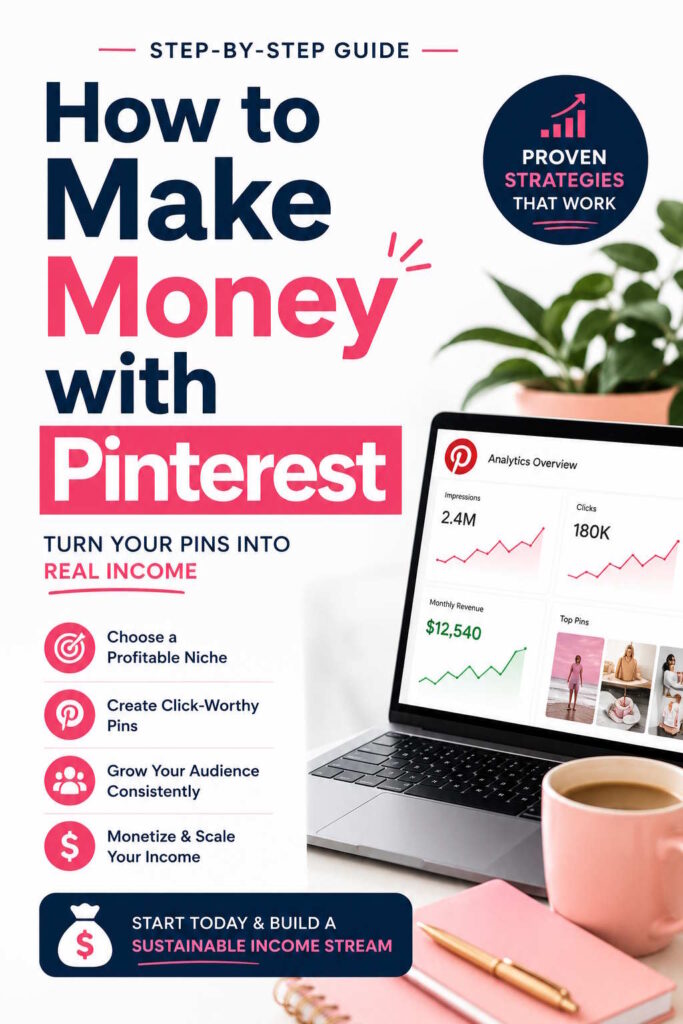
.jpeg "Earn Passive Income with Wall Art")
By XMoneyAcademy — researched platform mechanics, tested content frameworks, and compiled proven strategies to help beginners build a sustainable Pinterest traffic system.

At XMoneyAcademy, we’ve researched Pinterest marketing strategies, followed platform updates, tested content frameworks, and compiled proven best practices to help beginners build a sustainable Pinterest traffic system. This guide walks through exactly how Pinterest works, the income models that fit it best, and a step-by-step system you can start today — no guesswork, no inflated promises.
Most people still think of Pinterest as a place for recipes and wedding boards. That’s a mistake that costs beginners months of missed traffic. Pinterest is a visual search engine — closer to Google than to Instagram — and it remains one of the few platforms where a single piece of content can keep sending free traffic for years.
In this guide, you’ll learn what Pinterest actually is, eight proven ways to monetize it, how to set up your account correctly, how Pinterest SEO really works in 2026, how to design pins that get clicked, a full 90-day action plan, the mistakes that quietly kill beginner accounts, and where AI tools genuinely save time.
Table of Contents
- Chapter 1: What Pinterest Really Is
- Chapter 2: 8 Proven Ways to Make Money with Pinterest
- Chapter 3: Build Your Pinterest Account Correctly
- Chapter 4: Pinterest SEO Explained
- Chapter 5: How to Create Pins That Get Clicks
- Chapter 6: A 90-Day Action Plan
- Chapter 7: Common Mistakes to Avoid
- Chapter 8: AI Tools to Speed Up Your Workflow
- Chapter 9: Frequently Asked Questions
- Conclusion & Next Steps
Chapter 1: What Pinterest Really Is
Pinterest is a visual search engine. Users type a query — “small bathroom ideas,” “budget travel Morocco,” “passive income for beginners” — the same way they’d search Google, except the results are visual and saveable. This single distinction explains almost everything about why Pinterest marketing works differently from social media marketing.
The numbers: Pinterest reported an all-time high of 631 million global monthly active users in Q1 2026, up 11% year over year — its tenth consecutive quarter of double-digit user growth, according to the company’s official Q1 2026 earnings release.
Three structural traits make Pinterest valuable as a traffic source:
- Long content lifespan. A pin published today can still be surfacing in search results and earning clicks a year from now — very different from a social post that dies within 24–48 hours.
- Unbranded, high-intent search. Most top searches on Pinterest are unbranded (people searching for an idea, not a specific company), which means small creators and new sites can compete for visibility against big brands.
- Compounding growth. Because old pins keep resurfacing, traffic tends to build over time rather than reset every week — the work you do this month keeps paying out for months afterward.
Chapter 2: 8 Proven Ways to Make Money with Pinterest
Pinterest itself doesn’t sell anything — it’s a traffic layer. What determines your income is what that traffic is pointed toward. Here are eight models that work, in roughly the order most beginners should consider them.
1. Affiliate Marketing
Pins link to a blog post, review, or bridge page that recommends a product, which then links to your affiliate offer. This works especially well on Pinterest because users are frequently in active “looking to buy” mode when they search.
2. Selling Digital Products
Ebooks, templates, planners, and printables sold directly through Gumroad or your own checkout. Digital products pair naturally with Pinterest because they’re inherently visual and searchable by exact use-case (“teacher lesson planner printable,” “budget spreadsheet template”).
3. Blogging (Ad Revenue + Affiliate Combined)
Pins drive traffic to blog content monetized through display ads (AdSense, Mediavine) and embedded affiliate links. This model typically needs meaningful traffic volume (often 20,000+ monthly page views) before ad income becomes significant.
4. Etsy
Direct product pins linking to an Etsy listing. Performs especially well in visually-driven categories — home decor, jewelry, wedding, and stationery — where the product photo itself functions as the pin.
5. Shopify / E-commerce
Similar to Etsy, but for an independent store. Works best for products people research or plan before buying — home goods, apparel, gifts — since Pinterest users are often in a planning mindset rather than an impulse-buy one.
6. Coaching or Services
Pins link to a landing page or booking page for a coaching offer, course, or service. Works best when paired with a lead magnet (a free guide or checklist) rather than sending cold traffic straight to a sales page.
7. Email Marketing
Not a monetization method on its own, but a multiplier for all the others. Routing Pinterest traffic through an email opt-in before the final offer converts one-time visitors into an owned audience you can re-market to — which matters because any platform, including Pinterest, can change its algorithm.
8. Sponsored Content / Brand Partnerships
Once an account has meaningful reach in a niche, brands may pay for dedicated pins or campaigns. This model requires the most upfront audience-building and is typically a later-stage income source rather than a starting point.
XMoneyAcademy note: Most beginners get the best early traction by combining just two of these — for example, digital products plus email marketing, or affiliate marketing plus a simple blog. Trying to run all eight at once usually spreads effort too thin to rank well in any single one.
Chapter 3: Build Your Pinterest Account Correctly
Before any content strategy matters, the account foundation needs to be set up in a way Pinterest’s system can clearly interpret.
- Convert to a Pinterest Business account (unlocks analytics and rich pin data)
- Claim your website in Pinterest settings to attribute traffic and enable rich pins
- Write a keyword-rich profile name and bio describing exactly what you post about
- Create 5–10 boards around your core content pillars, each with a keyword-rich title
- Write a 2–3 sentence, keyword-natural description for every board
- Set a relevant Pinterest category for each board
- Add a clear, on-brand board cover image to each board
- Verify your website domain to build account-level trust signals
Chapter 4: Pinterest SEO Explained
Pinterest SEO means optimizing your pins, boards, and profile so Pinterest’s system can match your content to what people are actually searching for. It isn’t about tricking an algorithm — it’s about being unambiguous.
Core Ranking Factors
| Factor | What It Means |
|---|---|
| Relevance | Does the pin’s text and image content match the search query? |
| Visual clarity | Vertical format, readable text overlay, image that visually represents the topic |
| Freshness | Newly designed pins get an initial visibility boost, even linking to the same URL |
| Engagement | Saves and outbound clicks weigh more heavily than passive views |
| Account consistency | Steady daily activity builds account-level trust that helps every pin |
| Board organization | A small number of clearly labeled, topic-consistent boards outperforms a messy sprawl |
Keyword Research Process
- Type your core topic into the Pinterest search bar and record the autocomplete suggestions — these reflect real search volume.
- Check Pinterest Trends (Pinterest’s free trend tool) for seasonality and rising topics.
- Build a running list of 15–20 keyword phrases per content pillar, mixing broad terms with specific long-tail phrases.
- Use those exact phrases naturally in pin titles, descriptions, and board names.
Note on hashtags: Hashtags are no longer a major ranking factor on Pinterest. A few relevant ones won’t hurt, but natural-language, keyword-rich descriptions matter far more.
For platform-level guidance directly from Pinterest, see Pinterest’s official business resource hub.
Chapter 5: How to Create Pins That Get Clicks
A pin has about two to three seconds to communicate what it is and who it’s for. Everything below is designed around that constraint.
Search Query (keyword intent)
↓
Pin (image + title + description)
↓
Landing Page (matches pin’s promise)
↓
Offer (affiliate link, product, opt-in)
The Pinterest traffic funnel: every step must stay aligned with the one before it, or the click gets wasted.
Pin Design Checklist
- Vertical 2:3 ratio (1000×1500px)
- Clear, benefit-driven text overlay (a few words, readable on mobile)
- Image content visually matches the text — Pinterest’s system evaluates the image itself, not just the caption
- Consistent branding (font, colors, logo placement) across pins
- Unique description per pin — natural sentences, not a keyword list
- Alt text filled in for every pin
- Destination URL matches exactly what the pin promises
Chapter 6: A 90-Day Action Plan
| Phase | Days | Focus |
|---|---|---|
| Foundation | 1–7 | Set up business account, verify domain, write bio, create 5–8 boards with keyword-rich titles/descriptions. |
| 8–14 | Keyword research for your first 3 content pillars; build a running keyword list of 50+ phrases. | |
| Production | 15–30 | Design and publish your first 40–60 pins across those pillars; unique description and alt text for each. |
| 31–45 | Check Pinterest Analytics for early saves/clicks; double down on whichever pillar is performing best. | |
| Optimization | 46–60 | Refine landing pages and add email opt-ins on your top-performing pin destinations. |
| 61–75 | Batch-produce the next round of pins using a template system; test new keyword angles on underperforming pillars. | |
| Scale | 76–90 | Analyze which income model (Chapter 2) is converting best and shift more content production toward it. |
Chapter 7: Common Mistakes to Avoid
- Posting in bursts, then going quiet. Pinterest favors steady daily activity over sporadic uploads.
- Using horizontal or square images. These consistently underperform vertical 2:3 pins.
- Keyword-stuffing descriptions. Natural, readable sentences outperform robotic keyword lists.
- Skipping alt text. A free ranking signal most beginners ignore entirely.
- Mismatched landing pages. A great pin sending traffic to a page that doesn’t deliver on its promise wastes the click.
- Cross-posting new pins to every board at once. This dilutes the categorization signal Pinterest relies on for fresh content.
- Trying all 8 income models simultaneously. Spreads effort too thin to rank well in any one of them, especially early on.
Chapter 8: AI Tools to Speed Up Your Workflow
AI tools mainly save time on the two most repetitive parts of Pinterest marketing: writing and design.
- ChatGPT / Grok: Generating batches of keyword-rich pin titles and descriptions, and turning one blog post into multiple pin-angle variations.
- Canva AI (Magic Design): Producing multiple pin designs from a single template and reformatting to the 2:3 ratio quickly.
- Midjourney / Ideogram / Leonardo AI: Generating custom background imagery when stock photos feel generic — relevant since Pinterest’s system evaluates whether an image visually matches its topic.
The real time savings come from batching: generating a week’s or month’s worth of pin copy and drafts in one sitting, then refining rather than creating from scratch each day.
Want templates and tools built for exactly this workflow?
Explore XMoneyAcademy’s digital products and resources for Pinterest, affiliate marketing, and online income.Visit XMoneyAcademy
Chapter 9: Frequently Asked Questions
Is Pinterest still worth using for making money in 2026?
Yes. Pinterest reported an all-time high of 631 million monthly active users in Q1 2026, and its content behaves like search results rather than a social feed, meaning pins keep surfacing for months or years.
How much money can you make with Pinterest?
There’s no fixed number — it depends on your niche, offer, and consistency. Pinterest is a traffic and discovery channel; the income comes from what you point that traffic toward.
Do I need a website to make money on Pinterest?
No. Pins can link directly to an affiliate offer, product checkout, Etsy listing, or Shopify store, though a landing page in between often converts better.
How long does it take to see results on Pinterest?
Most consistent accounts see meaningful traffic within 60–90 days, though this varies by niche and optimization quality.
Is Pinterest better than Instagram or TikTok for making money?
They serve different purposes. Pinterest behaves like a search engine with long-lived, high-intent content, while Instagram and TikTok are built around real-time social engagement.
What is the best niche for making money on Pinterest?
Visually-driven niches like home decor, fashion, recipes, DIY, finance, and education perform especially well, but almost any niche with a visual angle can work.
How many pins should I post per day?
A sustainable range is 3–10 fresh pins daily. Consistency matters more than volume.
Do I need to pay for Pinterest ads to make money?
No. Organic Pinterest SEO can drive free traffic on its own; paid ads can accelerate results but aren’t required.
What is the fastest way to make my first sale on Pinterest?
Target one narrow, low-competition keyword, design a clear pin around it, and send traffic to a landing page that matches the pin’s promise exactly.
Are hashtags important for Pinterest SEO?
They’re a minor factor at most. Descriptions and image relevance matter far more in 2026.
Can I use AI to create Pinterest pins?
Yes — tools like Canva AI, ChatGPT, and AI image generators speed up design and copywriting, though the final pin should still accurately represent the linked content.
Does Pinterest work for affiliate marketing?
Yes. Pinterest users are frequently in active buying-research mode, which suits affiliate offers well when matched to a specific search.
Can beginners really make money on Pinterest without experience?
Yes, with consistency. Pinterest SEO mechanics are learnable and don’t require an existing audience to start, since most searches are unbranded.
How is Pinterest different from Google SEO?
Both rely on keywords and relevance, but Pinterest is far more visual — image quality directly affects ranking in a way Google’s text search doesn’t.
Should I link pins directly to affiliate offers or to my own blog first?
Both can work, but routing through your own blog or landing page first often converts better by building context before the offer.
What’s the biggest mistake beginners make on Pinterest?
Posting in inconsistent bursts and then going quiet, instead of maintaining a steady publishing rhythm.
Do old pins stop working after a while?
No — well-optimized pins routinely keep earning saves and clicks a year or more after publishing.
Is Pinterest good for selling digital products?
Yes, especially visual products like printables and templates, since they translate naturally into pin designs.
How important is pin design compared to keywords?
Both matter together — Pinterest’s system evaluates the image content alongside the text, so design and keywords need to align.
Can I repurpose blog content into Pinterest pins?
Yes — one blog post can typically be turned into multiple pin variations targeting different keyword angles, which is an efficient way to build volume.
Conclusion & Next Steps
Key takeaways:
- Pinterest is a visual search engine, not a social feed — treat keyword research and image clarity as the two pillars of every pin.
- Pick one or two income models from Chapter 2 to start, rather than spreading effort across all eight.
- Consistency (steady daily posting) outperforms sporadic high-volume bursts.
- Every pin, landing page, and offer in the funnel needs to stay aligned with the promise made in the search result.
- Old, well-optimized pins compound — the effort you put in now keeps paying out for months or years.
Ready to build your Pinterest income system?
Browse XMoneyAcademy’s related guides on affiliate marketing, digital products, and AI-powered content workflows to put this plan into action.Explore More at XMoneyAcademy
This guide reflects Pinterest’s publicly available platform mechanics, official company disclosures, and general digital marketing best practices as of 2026. It does not represent specific income guarantees, which vary by niche, effort, and execution.